
📷 Image: The Hindu (via NewsData)
Science
GITAM Scientist Samples Arctic Waters in Svalbard to Trace Organic Pollutants
✍️ The Hindu
🗓 30 Sep 2026, 06:45 AM
👁 20
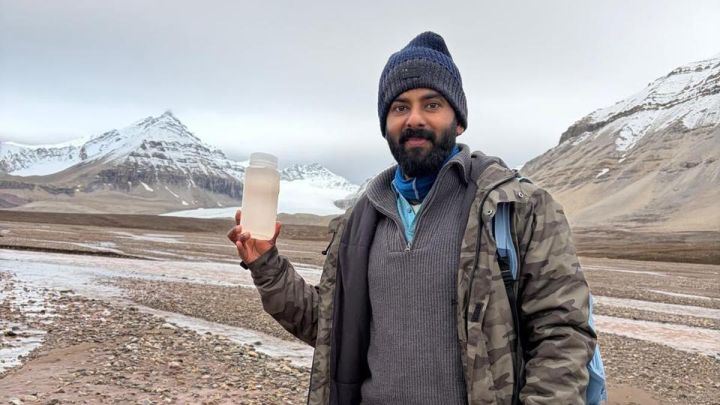
Researcher Manoj Panayamthatta Rayaroth collected fjord and glacier meltwater in Svalbard during the Indian Arctic Expedition 2026‑27 to examine how organic pollutants evolve in ice and enter the ocean.
A team from GITAM University, led by researcher Manoj Panayamthatta Rayaroth, reached the remote fjords of Svalbard as part of the Indian Arctic Expedition for 2026‑27. The fieldwork focused on gathering water samples from both the fjord system and melt streams feeding the glaciers.
The collected specimens will be analysed to track the chemical pathways of organic pollutants that become trapped in ice during winter and are released as the ice melts. By monitoring how these compounds transform and migrate into seawater, scientists hope to fill critical data gaps about contaminant dynamics in polar environments.
Understanding pollutant fluxes from the Arctic is vital for India’s broader climate and environmental monitoring agenda, as atmospheric transport can eventually affect the Indian subcontinent. The findings are expected to inform future policies on trans‑boundary pollution and contribute to global scientific databases on Arctic chemistry.
The expedition, scheduled to continue through the summer melt season, will also assess the impact of changing ice conditions on pollutant release, providing early indicators of how climate change may alter contaminant pathways worldwide.
The collected specimens will be analysed to track the chemical pathways of organic pollutants that become trapped in ice during winter and are released as the ice melts. By monitoring how these compounds transform and migrate into seawater, scientists hope to fill critical data gaps about contaminant dynamics in polar environments.
Understanding pollutant fluxes from the Arctic is vital for India’s broader climate and environmental monitoring agenda, as atmospheric transport can eventually affect the Indian subcontinent. The findings are expected to inform future policies on trans‑boundary pollution and contribute to global scientific databases on Arctic chemistry.
The expedition, scheduled to continue through the summer melt season, will also assess the impact of changing ice conditions on pollutant release, providing early indicators of how climate change may alter contaminant pathways worldwide.