
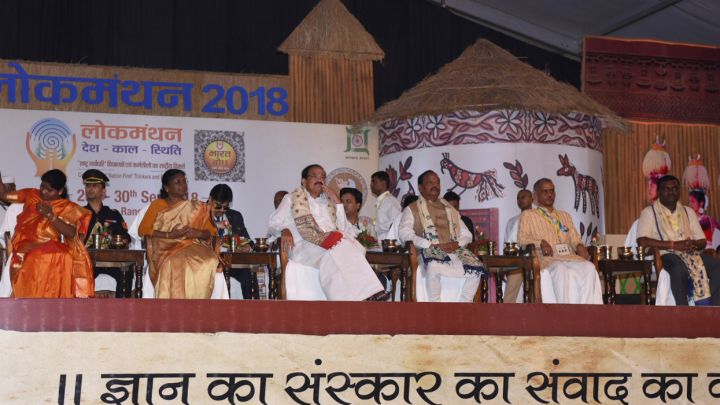
📷 Image: Wikimedia Commons / Vice President's Secretariat
Education
Vice President and Finance Minister to Attend Lok Manthan 2026 in Jaipur, Dec 4-6
✍️ Amar Ujala · Rajasthan
🗓 18 Nov 2026, 07:31 PM
👁 25
The Lok Manthan 2026 conference will be held at Jawahar Kala Kendra in Jaipur from Dec 4 to 6, featuring the Vice President, Finance Minister and other prominent figures, with 24 sessions on India’s knowledge heritage.
The Lok Manthan 2026 conference is scheduled to take place at Jawahar Kala Kendra, Jaipur, from 4 to 6 December. Organized as a platform to explore and celebrate India’s rich knowledge traditions, the three‑day event will host a series of discussions, workshops and cultural presentations.
Among the invited guests are the Vice President of India and the Union Finance Minister, along with several other senior officials and scholars from both India and abroad. Their presence underscores the government’s endorsement of the initiative and highlights the event’s national significance.
The programme comprises 24 sessions that will examine various facets of Indian intellectual heritage, ranging from ancient sciences and philosophy to contemporary applications. Experts from academia, research institutions and cultural bodies are expected to share insights and propose ways to integrate traditional wisdom into modern development.
Organisers anticipate a sizable audience of students, researchers, policy‑makers and the general public, aiming to foster dialogue that bridges historical knowledge with present‑day challenges.