
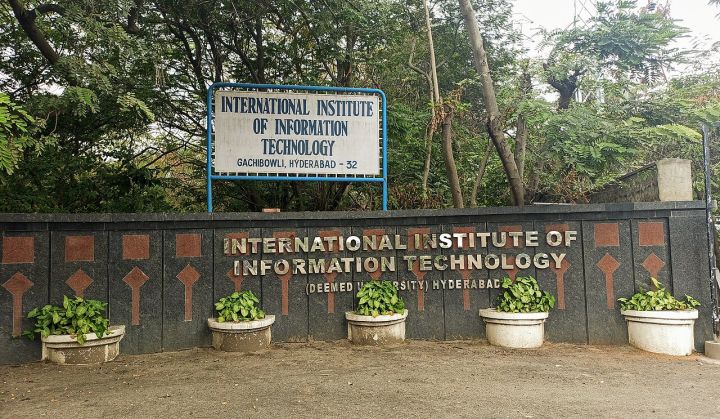
📷 Image: Wikimedia Commons / Kavali Chandrakanth KCK
Technology
IIIT Hyderabad Lab Unveils Low‑Cost Solution to Tame Chaotic Roads
✍️ Deccan Chronicle
🗓 22 Jul 2026, 03:18 AM
👁 43
Researchers at IIIT Hyderabad’s laboratory have announced a low‑cost technology aimed at reducing road chaos across India. The solution promises to improve traffic flow and safety without significant infrastructure overhaul.
The Information Technology Institute of Hyderabad (IIIT‑H) has announced a new low‑cost technology designed to address chaotic road conditions prevalent in many Indian cities. The lab’s researchers claim the solution can be deployed quickly and at a fraction of the cost of conventional traffic management systems.
While detailed specifications have not yet been released, the technology is said to integrate with existing road infrastructure and use real‑time data to optimize traffic signals and lane usage. Early trials reportedly showed a measurable reduction in congestion and an improvement in safety metrics.
Industry analysts suggest that if the system proves effective, it could be adopted by municipal bodies across the country, offering a scalable alternative to expensive road‑reconstruction projects. The IIIT‑H team plans to collaborate with local authorities to conduct pilot projects in the coming months.
The announcement was made during a press briefing at the university’s campus, where officials highlighted the potential for the technology to benefit both urban and rural traffic networks.
While detailed specifications have not yet been released, the technology is said to integrate with existing road infrastructure and use real‑time data to optimize traffic signals and lane usage. Early trials reportedly showed a measurable reduction in congestion and an improvement in safety metrics.
Industry analysts suggest that if the system proves effective, it could be adopted by municipal bodies across the country, offering a scalable alternative to expensive road‑reconstruction projects. The IIIT‑H team plans to collaborate with local authorities to conduct pilot projects in the coming months.
The announcement was made during a press briefing at the university’s campus, where officials highlighted the potential for the technology to benefit both urban and rural traffic networks.