
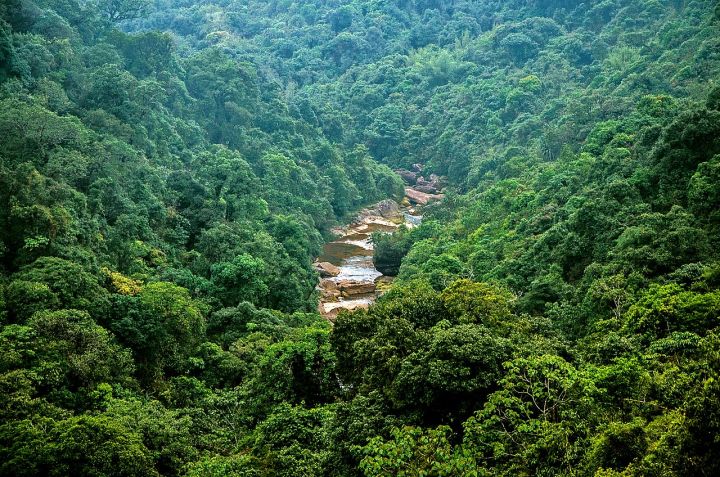
📷 Image: Wikimedia Commons / Ashwin Kumar
Science
Climate Change Threatens Habitat of Meghalaya's Endangered Tree
✍️ Hub News
🗓 27 Sep 2026, 10:01 PM
👁 6
Scientists warn that rising temperatures and altered rainfall patterns could shift the suitable habitat for Meghalaya’s critically endangered tree species.
Scientists studying the biodiversity of Meghalaya have identified a critically endangered tree species whose suitable habitat is at risk of shifting due to climate change. The species, which thrives in the region’s cool, misty forests, is already confined to a limited area and faces threats from habitat loss and human activity.
Modeling of future climate scenarios indicates that rising temperatures and changes in monsoon rainfall could make the current habitat unsuitable, forcing the tree to migrate to higher elevations or drier zones. Such a shift would not only reduce the species’ already small population but also disrupt the ecological balance of the forest.
Conservationists emphasize that the tree’s survival hinges on proactive measures, including detailed monitoring of climate impacts, protecting existing forest patches, and exploring assisted migration strategies. The findings underscore the broader vulnerability of Meghalaya’s unique flora to global warming.
Further research is needed to refine habitat suitability models and to develop a coordinated conservation plan that involves local communities, government agencies, and scientific institutions.
Modeling of future climate scenarios indicates that rising temperatures and changes in monsoon rainfall could make the current habitat unsuitable, forcing the tree to migrate to higher elevations or drier zones. Such a shift would not only reduce the species’ already small population but also disrupt the ecological balance of the forest.
Conservationists emphasize that the tree’s survival hinges on proactive measures, including detailed monitoring of climate impacts, protecting existing forest patches, and exploring assisted migration strategies. The findings underscore the broader vulnerability of Meghalaya’s unique flora to global warming.
Further research is needed to refine habitat suitability models and to develop a coordinated conservation plan that involves local communities, government agencies, and scientific institutions.