
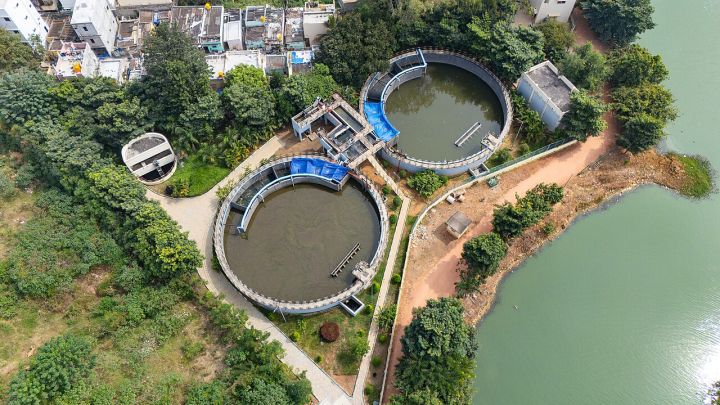
📷 Image: Wikimedia Commons / Vraj Acharya, WELL Labs
Local
Centre Told State’s Sewage Plants Running at Only 55% Capacity
✍️ The Times of India
🗓 04 Oct 2026, 03:47 AM
👁 13
The central government has been informed that sewage treatment facilities in an Indian state are operating at just over half of their designed capacity.
A recent communication to the Union government indicates that sewage treatment plants across an unnamed Indian state are functioning at merely 55% of their intended capacity. The figure suggests that nearly half of the infrastructure remains underutilised, raising concerns about wastewater management efficiency in the region. Officials highlighted that the shortfall could stem from operational challenges, inadequate maintenance, or insufficient inflow of sewage to meet design specifications. The central authorities have been urged to assess the situation and consider measures to optimise plant performance, potentially involving technical upgrades or policy interventions. Improving utilisation is seen as essential to safeguard public health and environmental standards, especially in rapidly urbanising areas.
The report did not disclose the specific state or the number of plants involved, but the capacity gap underscores a broader issue of infrastructure underuse in India's water sector. Stakeholders are expected to review the data and coordinate with state agencies to address bottlenecks and enhance the operational efficiency of existing facilities.
If the utilisation rate remains low, the financial viability of the plants could be jeopardised, prompting calls for a strategic review of investment and maintenance plans. The central government’s response will likely shape future actions to ensure that sewage treatment capacity aligns with the growing demand for clean water and sanitation services.
The report did not disclose the specific state or the number of plants involved, but the capacity gap underscores a broader issue of infrastructure underuse in India's water sector. Stakeholders are expected to review the data and coordinate with state agencies to address bottlenecks and enhance the operational efficiency of existing facilities.
If the utilisation rate remains low, the financial viability of the plants could be jeopardised, prompting calls for a strategic review of investment and maintenance plans. The central government’s response will likely shape future actions to ensure that sewage treatment capacity aligns with the growing demand for clean water and sanitation services.