
📷 Image: Wikimedia Commons / Ms Sarah Welch
Science
3.5‑billion‑year‑old Jharkhand rock may hold Earth’s oldest microbial evidence
✍️ Organiser
🗓 30 Aug 2026, 11:48 PM
👁 42
Scientists examining a 3.5‑billion‑year‑old rock from Jharkhand say it contains structures that could represent the earliest known microbial life on Earth.
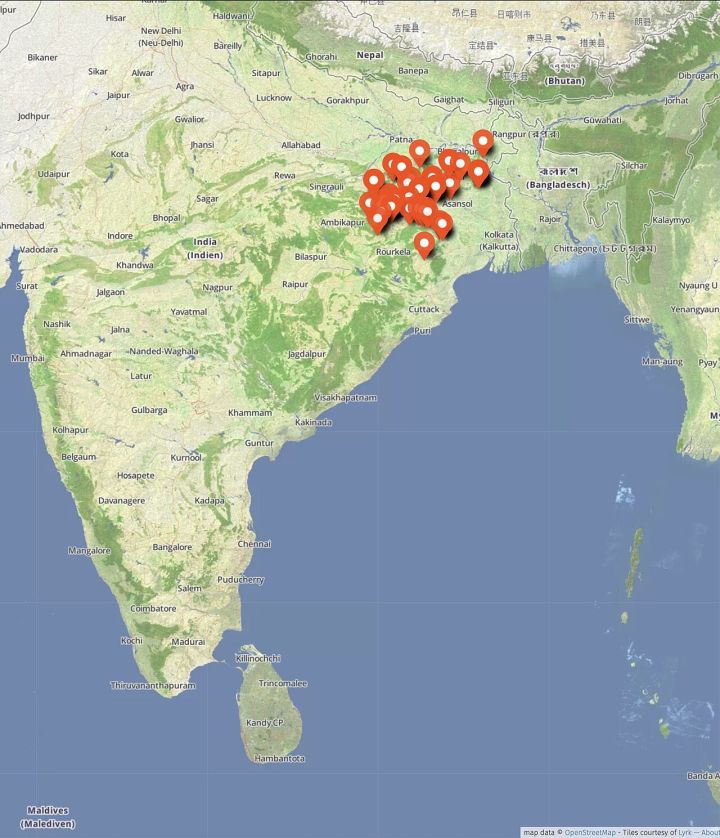
Researchers studying a rock sample dated at about 3.5 billion years old, recovered from a remote outcrop in Jharkhand, have reported the presence of microscopic features that resemble ancient microbial colonies. The rock, identified through radiometric dating techniques, belongs to the Archean era, a period when the planet’s surface was still forming and life, if present, was limited to simple organisms.
Detailed petrographic analysis revealed filamentous and spherical structures embedded within the mineral matrix, which the team interprets as possible fossilized remains of early bacteria or archaea. Such morphologies are consistent with previously documented microfossils from other Precambrian sites, but the Jharkhand specimen is notably older than most known examples.
If confirmed, the finding would push back the earliest direct evidence of life on Earth by several hundred million years, challenging existing timelines that place the origin of life around 3.2 billion years ago. The discovery adds India to a short list of regions, such as Western Australia’s Pilbara and South Africa’s Barberton Greenstone Belt, that have yielded some of the planet’s oldest biological clues.
The research team emphasizes that further geochemical testing, including isotopic studies, is required to rule out abiotic explanations. Peer‑reviewed publication of the results is expected later this year, and the rock will be preserved for ongoing investigations into Earth’s primordial biosphere.
Detailed petrographic analysis revealed filamentous and spherical structures embedded within the mineral matrix, which the team interprets as possible fossilized remains of early bacteria or archaea. Such morphologies are consistent with previously documented microfossils from other Precambrian sites, but the Jharkhand specimen is notably older than most known examples.
If confirmed, the finding would push back the earliest direct evidence of life on Earth by several hundred million years, challenging existing timelines that place the origin of life around 3.2 billion years ago. The discovery adds India to a short list of regions, such as Western Australia’s Pilbara and South Africa’s Barberton Greenstone Belt, that have yielded some of the planet’s oldest biological clues.
The research team emphasizes that further geochemical testing, including isotopic studies, is required to rule out abiotic explanations. Peer‑reviewed publication of the results is expected later this year, and the rock will be preserved for ongoing investigations into Earth’s primordial biosphere.