
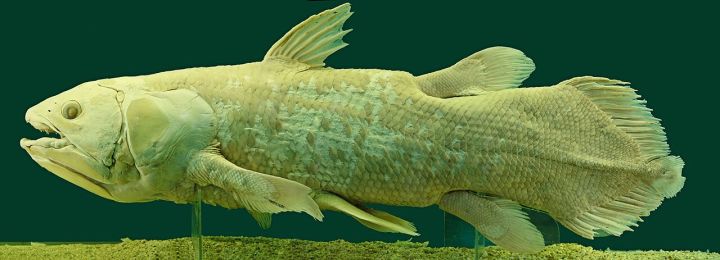
📷 Image: Wikimedia Commons / Alberto Fernandez Fernandez
Science
1938 Coelacanth Discovery: The Living Fossil That Shocked the World
✍️ The Times of India
🗓 03 Aug 2026, 08:39 PM
👁 37
In 1938, a South African fisherman caught a strange fish near St. Paul’s Rocks, revealing the coelacanth, a living fossil thought extinct for 400 million years.
In 1938, a South African fisherman named Harry Miller caught an unusual fish near St. Paul’s Rocks, off the coast of the Cape of Good Hope. The specimen, later identified as a coelacanth, was a living fossil that had been presumed extinct for 400 million years. The discovery stunned the scientific community and was hailed as one of the most sensational natural history events of the twentieth century.
The coelacanth’s anatomy—such as its lobed fins and a fossilized skull—mirrored ancient fish from the Devonian period, providing a living link to the distant past. Its appearance confirmed that some lineages survived major mass extinctions, reshaping our understanding of evolutionary resilience.
Since the initial find, researchers have studied the coelacanth’s biology, genetics, and habitat. The species is now known to inhabit deep waters off the coasts of South Africa and Indonesia, and conservation efforts aim to protect its fragile population.
Today, the coelacanth remains a symbol of the mysteries still hidden beneath the oceans, reminding scientists that the past can still surface in surprising ways.
The coelacanth’s anatomy—such as its lobed fins and a fossilized skull—mirrored ancient fish from the Devonian period, providing a living link to the distant past. Its appearance confirmed that some lineages survived major mass extinctions, reshaping our understanding of evolutionary resilience.
Since the initial find, researchers have studied the coelacanth’s biology, genetics, and habitat. The species is now known to inhabit deep waters off the coasts of South Africa and Indonesia, and conservation efforts aim to protect its fragile population.
Today, the coelacanth remains a symbol of the mysteries still hidden beneath the oceans, reminding scientists that the past can still surface in surprising ways.